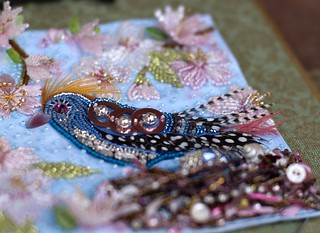
The incredible textiles that were woven for the wedding kira and the weavers who vied for the honor. The textiles that decorated the village and its people.
The fact that no foreign diginitaries were invited...the king wanted to keep it simple and traditional. Just a king, his bride, the buddhist monks, and his people.
The fact that thousands of Bhutanese citizens walked for hours in the cold to attend...to celebrate love and the marriage of their accessible king...the king whose father was the only monarch to voluntarily abdicate his throne to democracy (unsolicited).
And this is my favorite picture I found on the Queen's facebook page (go figure). It's the day before the wedding and the couple was on their way to receive an official blessing.
I think they found it in the offerings of the people.
Bhutan, one of the most remote and insular places on earth, was the inventor of the Gross National Happiness Index (GNH). I find many of the news reporters today are almost laughing when they mention that fact in their royal wedding coverage. As if it's silly to even imagine such a thing.
But here are the Four Pillars of Gross National Happiness in Bhutan:
Sustainable development
Environmental protection
Cultural preservation
Good governance
Now that's inspiring.
I hope big happiness comes to this small nation so the rest of us can learn from them.
My trip to NYC with Shirlee could be titled "Treasure Trove Unearthed".
She chose Sarah Burton from Alexander McQueen AND the Royal School of Needlework had their hands all over this dress!! Hallelujah!
And...she used British companies exclusively to design the gown and source the supplies...And she honored the royal wedding heritage by displaying motifs of the rose, shamrock and thistle...And...
Well, here's the official press release...I've included the whole thing because it tells so much of the story, I just didn't want you to miss a thing...
The Wedding Dress
Miss Catherine Middleton’s Wedding Dress has been designed by Sarah Burton at Alexander McQueen.
Miss Middleton chose British brand Alexander McQueen for the beauty of its craftsmanship and its respect for traditional workmanship and the technical construction of clothing. Miss Middleton wished for her dress to combine tradition and modernity with the artistic vision that characterises Alexander McQueen’s work. Miss Middleton worked closely with Sarah Burton in formulating the design of her dress.
The dress epitomises timeless British craftsmanship by drawing together talented and skilled workmanship from across the United Kingdom. The dress design pays tribute to the Arts and Crafts tradition, which advocated truth to materials and traditional craftsmanship using simple forms and often Romantic styles of decoration. Ms Burton’s design draws on this heritage, additionally giving the cut and the intricate embellishment a distinctive, contemporary and feminine character.
The design
The lace appliqué for the bodice and skirt was hand-made by the Royal School of Needlework, based at Hampton Court Palace. The lace design was hand-engineered (appliquéd) using the Carrickmacross lace-making technique, which originated in Ireland in the 1820s. Individual flowers have been hand-cut from lace and hand-engineered onto ivory silk tulle to create a unique and organic design, which incorporates the rose, thistle, daffodil and shamrock.
Hand-cut English lace and French Chantilly lace has been used throughout the bodice and skirt, and has been used for the underskirt trim. With laces coming from different sources, much care was taken to ensure that each flower was the same colour. The whole process was overseen and put together by hand by Ms Burton and her team.
The dress is made with ivory and white satin gazar. The skirt echoes an opening flower, with white satin gazar arches and pleats. The train measures two metres 70 centimetres. The ivory satin bodice, which is narrowed at the waist and padded at the hips, draws on the Victorian tradition of corsetry and is a hallmark of Alexander McQueen’s designs. The back is finished with 58 gazar and organza covered buttons fastened by Rouleau loops. The underskirt is made of silk tulle trimmed with Cluny lace.
The Fabrics
French Chantilly lace was combined with English Cluny lace to be hand-worked in the Irish Carrickmacross needlework tradition.
All other fabrics used in the creation of the dress were sourced from and supplied by British companies. The choice of fabrics followed extensive research by Sarah Burton and her team.
The Royal School of Needlework
The Royal School of Needlework (RSN), based at Hampton Court Palace, assisted the Alexander McQueen team in accurately cutting out the delicate motifs from the lace fabrics and positioning the lace motifs with precision into the new design. The lace motifs were pinned, ‘framed up’ and applied with stab stitching every two to three millimetres around each lace motif. The workers washed their hands every thirty minutes to keep the lace and threads pristine, and the needles were renewed every three hours, to keep them sharp and clean.
The RSN workers included existing staff, former staff, tutors, graduates and students, with the youngest aged 19.
The RSN’s work was used primarily for the train and skirt of the Bride’s dress, the bodice and sleeves, the Bride’s shoes and the Bride’s veil.
A nice shot of the Cartier Halo Tiara loaned by the Queen
Veil and Jewellery
The veil is made of layers of soft, ivory silk tulle with a trim of hand-embroidered flowers, which was embroidered by the Royal School of Needlework. The veil is held in place by a Cartier ‘halo’ tiara, lent to Miss Middleton by The Queen. The ‘halo’ tiara was made by Cartier in 1936 and was purchased by The Duke of York (later King George VI) for his Duchess (later Queen Elizabeth The Queen Mother) three weeks before he succeeded his brother as King. The tiara was presented to Princess Elizabeth (now The Queen) by her mother on the occasion of her 18th birthday.
The Bride’s earrings, by Robinson Pelham, are diamond-set stylised oak leaves with a pear shaped diamond set drop and a pavé set diamond acorn suspended in the centre. Inspiration for the design comes from the Middleton family's new coat of arms, which includes acorns and oak leaves. The earrings were made to echo the tiara. The earrings were a personal gift to the Bride from her parents for her Wedding Day.
Robinson Pelham have also designed and made a pair of diamond earrings for Miss Philippa Middleton. These earrings are more floral in nature to compliment the headpiece worn by Miss Philippa Middleton during the Service.
A tourmaline and diamond pendant and matching earrings have been designed and made for Mrs. Carole Middleton. Two gold stick pins, one with a single gold acorn at the head and the other with an oak leaf, are also worn respectively by the Father of the Bride, Mr. Michael Middleton, and the Bride's brother, Mr. James Middleton.
Wedding Shoes
The wedding shoes have made hand-made by the team at Alexander McQueen and are made of ivory duchesse satin with lace hand-embroidered by the Royal School of Needlework.
Isn't that wonderful? I hope someone tells the story of all those folks working their fingers off at Hampton Court Palace!
Carrickmacross lace is a type of handmade needlelace originating in Carrickmacross Ireland in the 19th century. It's made by attaching a thin muslin to a machine netting (in Kate's case...a silk tulle) and, using a pattern to outline and cut away the design.
Here is a beautiful example of Carrickmacross lace...
I think my favorite part was the sheer veil covering Kate's face...I loved that the silk shimmered when the cameras panned in for a close up. I loved the embroidery on the edging of the veil.
I'm afraid we'll have to wait for the close-up photography shots to come in before we can actually see the embroidery on the bodice and the train. From far away, it just all looks white. In my experience, these detailed shots can take quite a while to surface in the media. Though you can see a hint of the embroidery on the bottom of the gown in this pic...
I understand that she had 3 underskirts and shoes that were also all hand embroidered.
The whole look drew me in and made me want to look a little more closely at the new Princess.
And maybe that was her message. I'm here. I'm honoring tradition. I'm a classy woman. But you're going to have to work a little harder to really know me.
P.P.S. And wouldn't I love to have seen a close-up of the embroidery on the back of the Archbishop of Canterbury's cope? It looked stunning...does anyone know any details about that? Check it out on the video replays and you'll see what I mean...Update: Thanks to Mary Corbet, we now know all the details about the Cope -- check out her blog post here!
P.P.P.S. Thanks to Flower Friend for letting us know...you can read today's press release by the Royal School of Needlework here. Too cool.
I love history and I love all types of needlework.
Princess Grace Kelly on her wedding day 1956
So, when the opportunity arises in my modern life, to combine a historical moment with the possibility of a fabulously embroidered, jewel-encrusted, sequin-laden, hand-sewn silk gown trimmed with the world's finest laces and the most exquisite attention to detail...
Close-up of Princess Grace's headdress
I anticipate something spectacular. I can't help it. I'm convinced that we're in for a stunning, modern marvel of handwork tomorrow in the form of Kate Middleton's wedding dress.
And it's not just the dress itself...but it's the stories behind the creation of the gown...about the people who have labored for months and the hands that have crafted every little component...that I am eager to hear.
Many of the royal gowns that have preceded Kate's have been marvelous historical showpieces of embroidery, bobbin lace, tambour beading, silk weaving, etc.
One of my absolute faves was the gown of Princess Charlotte in 1816...
It was made by Mrs. Triaud of Bolton Street from 'cloth-of-silver', silk bobbinet embroidered with heavy silver lame embellished with Brussels lace, and with embroidered flowers and shells festooning the hem. ~telegraph.co.uk
And lucky for us, here is a beautiful video showing much of its gorgeous detail:
It's a complete stunner, isn't it?
Next was Queen Victoria, the first reigning British Queen to be married and who married for love to Albert in 1840 -- and her dress was designed to make a political statement.
One of the main concerns in late 1830s England was the effect the Industrial Revolution was having on traditional textile industries. In particular, the invention of machine laces was decimating handmade lace industries across England, and causing widespread poverty and unemployment among the skilled artisans.
In order to stimulate and support the lace industry, Victoria chose for her wedding dress a large piece of handmade Honiton lace. The rest of the dress then became a vehicle to showcase the lace, and white was chosen as the most suitable colour to do this. In the case of Victoria’s dress, white symbolised practicality and patriotism, rather than purity. (Source: The Dreamstress Blog)
The lace production was overseen over a six week period by "Miss Bidny" and took nearly 200 lacemakers in the towns of Beer and Honiton to make it.
In 1923, Elizabeth Bowes-Lyon married Prince Albert and her dress was a simpler, straight-lined gown whose style you'll recognize as representative of the 20s...
I couldn't find much about the story of her gown though I can see that veil was lace and the bodice and skirt were heavily beaded. This gown has just been approved by the Queen for display in honor of Kate and Will's big day so maybe I'll learn more of its history then.
Then comes the gown of Queen Elizabeth II...
The embroiderers were out in full force for this baby!
The veil and the 15-foot train were a tour de force of dressmaking. Designed by Norman Hartnell (he also designed Elizabeth's coronation gown which I talked about here), the silk, duchesse satin dress was embroidered with 10,000 seed pearls imported from the United States and crystal beads in garlands of star-shaped lily heads, white York roses with orange blossoms and the heads of wheat (a symbol of fertility) -- and all of that embroidery was duplicated on the silk tulle train...
I love the idea that the veil was embroidered tulle. The transparency of the tulle really showed off the embroidery on the train.
I'm afraid if I had been there, I'd have been watching the beautiful embroidery on the train as it went by rather than the bride!!
And then there was Princess Diana...
I was 16 when she was married in 1981 and I'll never forget that day or her dress. It really affected me much in the same way that Princess Grace of Monaco's wedding in 1956 affected my mother.
And thanks to this amazing book...
Which tells the entire story of the making of Diana's dress -- all the design ideas, the sourcing of supplies, the people that wove the silk, made the lace, sewed the sequins -- I get to vicariously work alongside the dressmakers and couturiers who made this amazing dress.
It's a great read and I was able to find it at my library.
Designed and created by the small design house of David and Elizabeth Emanuel, the dress was made from ivory silk taffeta woven at Sudbury Silk Mills in Suffolk.
The lace for the bodice was actually a piece of historic Carrick lace originally given to the Royal School of Needlework by Queen Mary to use for a lace fund set up during World War I. Donated laces were used to make up articles such as cushions, scent sachets, nightdress cases, etc. These items were sold and the proceeds used for a fund for the Soldiers, Sailors and Airmens Association.
And onto the lace bodice and the hundreds of metres of other laces, were embroidered pearls and mother-of-pearl sequins -- thousands of them!!
All done by hand, it was taking longer than anticipated so the design house decided to outsource the embroidery of the veil. Here's one of my favorite excerpts from the book...
We decided we would have to send the veil out to be embroidered. Who better to call upon than our trusted friend and embroiderer, "Miss Peggy" Umpelby at S. Lock Ltd. We asked her to hand-embroider a staggering 10,000 3mm sequins onto the veil. She decided that because of the secrecy of the whole project, she would do all this at home. She spent the best part of two weeks with a huge tambour frame in her living room - large enough to take the veil, which measured 11.5 foot by 40 foot. The only thing that annoyed Miss Peggy was her friends at work asking why, after two weeks holiday (as she had told them), she did not have a better sun tan. (Source: A Dress for Diana by David Emanuel and Elizabeth Emanuel)
And that, my friends, is a beautiful part of Diana's royal wedding story that is now history.
Who has made the stitches and sewn the sequins for Kate's dress?
Who is the "Miss Peggy" Umpelby of 2011?
I hope we get to "meet" her...and I hope somebody tells her story...
And so on the eve of the big day, I pray that Kate hasn't opted to be so modern of a bride that she doesn't honor the rich royal wedding history of the hand-wrought couture gown.
I pray for beads that blind us and embroidery that moves us to tears. I pray for exquisite handmade lace and for silk fabrics that carry the day.
Oh...And for the good fortune of the happy couple...
I absolutely love the zaniness of a knitted royal wedding party...
It's one of the most creative ways to commemorate the big event that I've seen.
And it truly tickles my funny bone...though I really have no desire to actually knit the royal wedding party myself.
That being said, you corgi lovers might be tempted to knit a miniature version of your pooches...
Fiona Gable has a great sense of humor and is famous for her knitted holy family published in Knitivity as well as a book of knitted monsters. She cracks me up.
She even includes a knitted spoof on the famous engagement picture...
I think she nailed the famous wrap on Kate's dress.
And just to make you smile even more and send you into your weekend just a bit on a light note...
Take a couple of minutes and watch this video put out by the publisher Ivy Press (you'll be happy to know that the corgis are prominently featured -- turn up your volume)...
The Diet Coke, the chippy nail polish, the crooked crown, the shabby sash...
This amazing actress is playing yet another queen after her great performance as the Red Queen in Tim Burton's Alice in Wonderland. She is playing Queen Elizabeth to George VI in the movie, The King's Speech, which I am SO excited to see this weekend...
Seems like there is so much talk of royalty these days with the impending marriage of William and Kate. I have to admit I get swept up by it all and thought that this modern wedding sampler designed by Jacqui Pearson of Granny Knits, to be published in the upcoming March issue of UK mag Cross Stitcher, was kind of fun...
I don't plan to stitch it but it's cute and a far cry from the more formal samplers I've seen in the past...like these two that were stitched for Charles and Diane courtesy of Linens and Royals blog....
Beth Russell also created this needlepoint design to honor Will and Kate's big day: