My father lives in a place called Pelican Bay in Naples, Florida...

So named for the pods of Brown Pelicans that fish and make their homes there...
When Pelican Bay was developed back in the 1970s, it was done with preservation and conservation in mind. When many developers in the area had removed the tangles of mangroves that separated the public from the beach, Pelican Bay chose to preserve almost all of the its 500+ mangrove acres.

In the past Jim and I have visited at Easter time when Jack had his Spring break; a time when many children and grandchildren were visiting their families and the Pelican Bay beaches were fairly crowded. This year Jim and I visited just last week...pre-Spring break crowds.
Or so we thought.
What we experienced was a very different type of beach crowd...

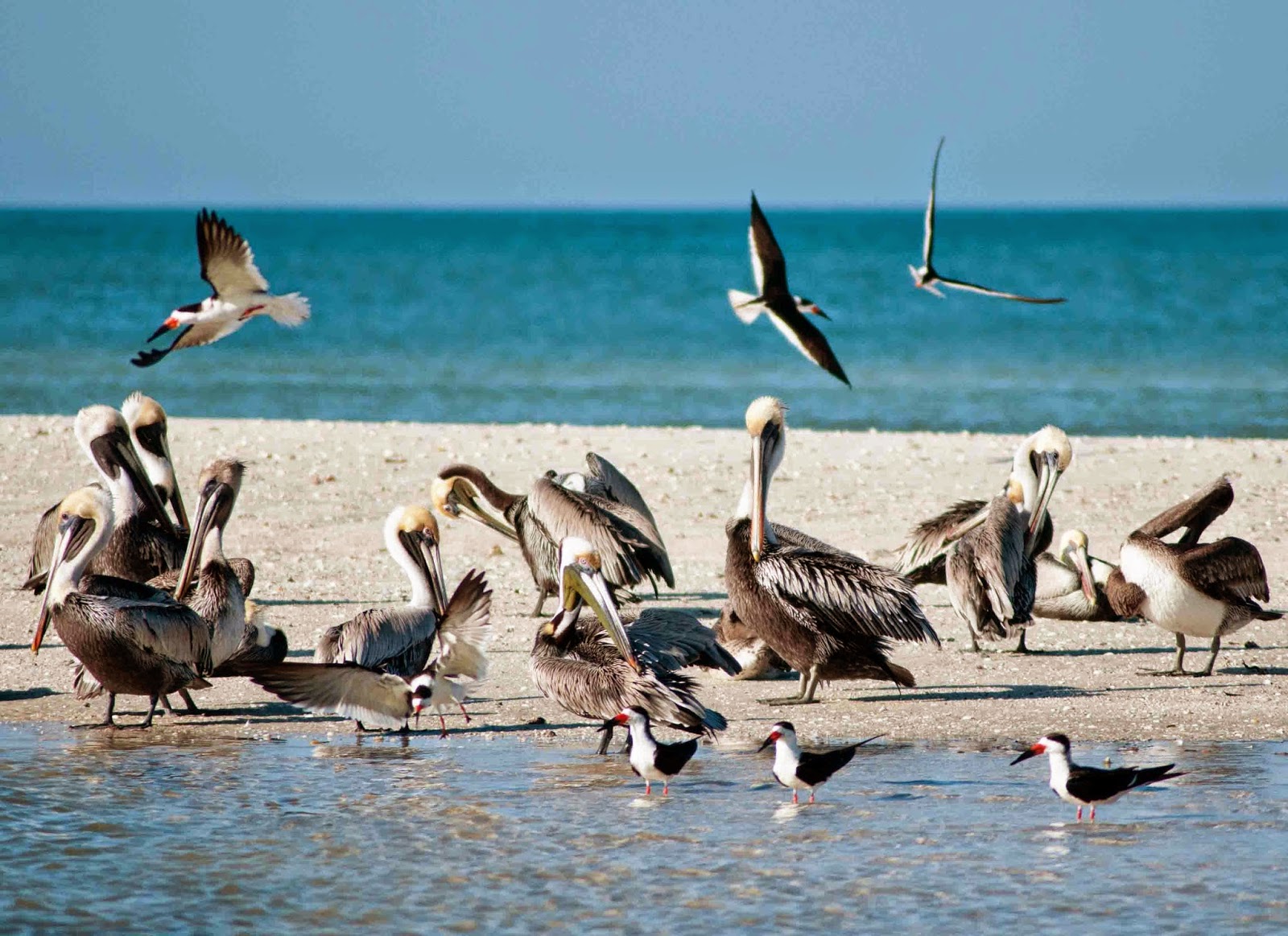
As far as the eye could see down the two miles of private beaches...were flocks and flocks of sea birds.

Most commonly, the Royal Tern with its tufted black crown...

And the Black Skimmer with its unique, uneven candy-corn bill...

The Black Skimmer is the only bird with an uneven bill which allows it to skim along, plowing the water with its lower mandible until the top snaps closed when contacting a fish. They fish by feel not by sight.
 |
| Audubon's watercolor of the Black Skimmer, plate no. 323 |
The birds tend to forage in the very early morning so by the time we got to the beach, they were tired and resting as modeled by this group of sleepy sandpipers...

We tried to slip quietly by them in order to find our way to the wrack line...

A place where the sea has a daily message to deliver.
We are never sure what we are going to find there.
And we've learned not to go with any expectations. If you go looking for one thing in particular, then you just might miss the story that you were meant to see.

This year, calling cards from the seabirds were everywhere; feathers littering the beach and sticking out from piles of shells.
Feathers blown about, landing in the water, and washing back up onto shore...

Feathers sopped with sea and salt adding their own tale of abandonment to the vacated shell houses which shared the beach.

I scooped up a few handfuls of them...both the primary flight feathers and some of the secondaries.
Having studied the pictures of them in flight, I thought for sure that I was collecting the feathers from the Black Skimmers...

When I got home and checked in my feather book, it turns out that the feathers were most likely from the Terns...
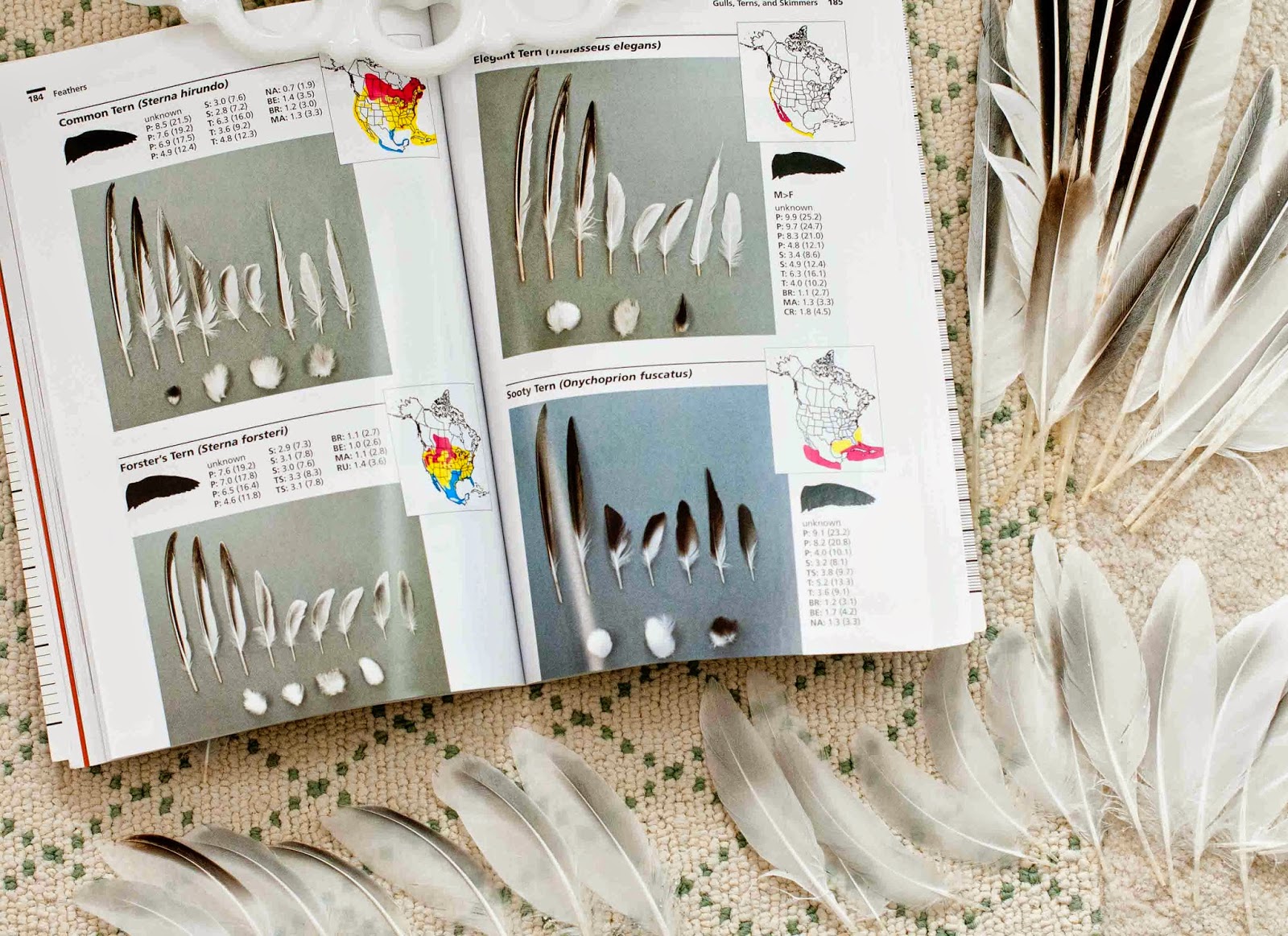
The Black Skimmer feathers are mostly deep gray to black. Who knew?
Not everything that ends up in the wrack line is void of life.

We found both the nine-armed sea star above and the brittle sea star below, tossing them back in case there was some life yet left in them. Better safe than sorry but I fear the Brittle star was already dead.

The other common theme in the piles this year were barnacles.

They had colonized on many of the bits of shells and seemed to be more prevalent than usual.
We even found two sand dollars and both of them had barnacle squatters attached...

So I collected those too and took it as a sign that I should finally read this book that I bought after my immersion into the barnacles of the tidepools of Maine.

The book will be happy to hear that it's been promoted to the on-deck reading circle and is fourth in queue.
One of the most exciting sightings this trip was seeing a Roseate Spoonbill.
It was resting at the edge of the mangroves in Clam Bay when Jim and I went for a walk...

Can't see it? It's that speck of pink to the left. Unfortunately, we only had a phone camera so that's as good as it gets.
I've only seen them three times in the 15 years we've been traveling to visit Dad.
Even though I didn't have a good picture to share, Mr. Audubon showed up at just the right moment.
In last Friday's Wall Street Journal there was an article announcing "Audubon's Aviary: The Final Flight"; the third and final installment of the New York Historical Society's exploration of the 435 watercolors that Audubon executed for "The Birds of America", a series of engraved, hand-colored prints that appeared between 1827 and 1838.
And there, right on the front page of the Weekend Arts II section was a picture of my pink-feathered friend á la Audubon...
 |
| Audubon's watercolor of the Roseate Spoonbill, plate no. 64 |
Come on! You'd be excited too if you saw THAT!! What a nonconformist creature of pink perfection. I couldn't dream up that bird in a million years. I was so glad to see it again.
When it was finally time for us to pack up our treasures and come home, my father asked...
"What the heck are you going to do with all those shells?"

I don't know just yet.
But they are cleaned, sorted and waiting in a collection box...

For their next day in the sun.
Good Monday everyone.