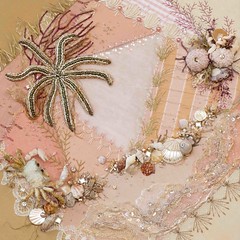
While photographing this vintage ribbonwork purse, my thoughts kept wandering back to a book I finished in August, What Makes Your Brain Happy and Why You Should Do the Opposite by David Di Salvo.
by David Di Salvo.
One of the most fascinating concepts laid out in the book was the notion that our brains really like things the way they are and don't like to be threatened. Our brains develop schema, mental maps of concepts that we place together by association. This is very helpful to our survival as we gain speed in evaluating new inputs so we can respond more quickly to them. It's how we adapt and learn.
Our brains like it when new information fits into one of our pre-established schema, aka 'certainty bias'. In fact, we crave certainty.
When new information does not match our pre-determined schema, the brain is threatened and the reward center powers down. In other words, it's uncomfortable and our brains will work hard to restore peace and harmony.

Though we may enter into a discussion with someone of opposing views with the best of intentions to be open-minded and really "hear" what the other person is saying, our brains will work very hard to selectively ignore information inconsistent with our schema or beliefs.
In fact, the most shocking take-away for me from the book was that..
Our brain may not even hear, see or process the information at all...as if the information had never been transmitted in the first place. (Here's a link to an interesting excerpt from the book if you're interested.)
Wow. I've been missing a lot. What a filter we have to overcome to take in new information!
So why, you ask, am I thinking of this book when I am photographing the beautiful vintage ribbonwork on this old purse?

I think it's because the process of photography...laying out the picture, selecting the angle in the viewfinder, editing the photos, gives our brains a second, third and fourth chance to take in information that we wouldn't have seen the first time around.
If someone had merely brought the purse to a meeting to share, I might have gotten the general impression of the beauty of the work. I definitely would have noticed the uses for picot edged ribbon that were new to me. But I would have left with just an overall impression.

But I would have left with just an overall impression.
Taking a picture allows us to re-see the image anew. It allows us to study. To go back over the image that we've looked at many times and find something we haven't seen before.

And our filters, our schema, greatly influence what we're picking up in the photos.
If I've taken ribbonwork classes, I might be focused on the ribbons and how they were sculpted.

If I'm a crewel artist, I might be interested in the colors and the shading of the leaves and how the blending of the silk buttonhole twist works differently than wool...

If I have struggled to compose my own floral designs, I might look at the overall composition and its balance.

Maybe it's the texture; maybe it's the stitches...
I cannot predict what you will "see"...but I do know that none of us sees it all.

I know I didn't see all the shades of brown, green, blue and gray threads used in the leaves and vines until I looked closer.
I didn't see the thorns on the branches.

I was too busy looking at the beautifully stuffed rosebuds and how I wanted so badly to make them.
And so we must work hard to see more than what is most obvious.
To push beyond our first impression.
And so...
Take a picture, it lasts longer.
And then...
Share it with someone.
They may see something you missed.
Look again...

...what did you see?