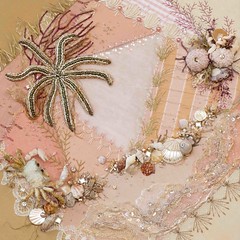
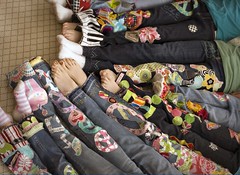
I wasn't even going to post today. I have too many things on my to-do list -- that was, until Cindy Powers of Dancing on Temple Tops sent me into a tailspin when she posted about Korean Embroidery.
 From Cindy's blog
It turns out that on my trip to the Asian Art Museum in San Francisco, I had found and photographed these two contemporary examples of pojagi (which now, I believe are by artist Chunghie Lee, someone let me know if I'm correct) .


Of course, at the time, I had no idea what they were. I just thought they were beautiful and they reminded me of the work of Karen Ruane of Contemporary Embroidery.
Unasu on Flickr has posted pictures of some of her mother's pojagi work and here is one of my favorites...

And another one of my favorites from her Mom --

though it is less traditional pojagi and more reminiscent of cathedral windows -- but isn't it stunning?
I also went to my Silken Threads book and found this information about pojagi:
The patchwork wrapping cloths (pojagi) that served as common household items in the Choson period may have developed from forms used in Buddhist contexts. A number of exquisite patchwork cloths made from early Chinese fabrics have been preserved in Tibetan temples, where they were used for covering altar tables and wrapping scriptures....The popularity of patchwork furnishings in Tibet no doubt can be attributed to the lack of domestic silk production in this region as well as the Buddhist renunciation of material wealth. Korean pojagi were created in several different forms, each for a specific use. Those with attached strips of cloth were intended for wrapping gifts, those with loops in the middle of the cloth functioned as food-tray covers, and those with tassels on the corners were used as table covers.
Evidently there were many types of pojagi some more elaborate and embroidered silk pieces used for the royal classes and other more common types made from ramie and cottons used by the masses. It's fascinating to me...the Japanese have become very interested in this art form and antique pojagi are being prized by collectors...who knew?
For $500, this antique piece found here could be yours!

Here is a great little video put together by a student at the Seoul Women's University.
And I can't help but share these pictures from my inspiration file of contemporary Korean hanbok published in Vogue Korea in 2007. Who knew that they would be seen here today when I put them aside so many months ago??


Now I really must get back to the tasks at hand...Hope you enjoyed this tour of Korean needlework...
Note: Cindy just emailed me with this additional piece of info...
The difference between pojagi and american patchwork is that the
seams are somewhat like a flat fell so that the resultant patchwork
is finished on both sides. Rather than being padded and quilted, the
patchworked fabric is light, floaty and airy. Often they are
displayed on lightboxes or over windows so that the light can shine
through like stained glass windows.