Showing posts with label goldwork. Show all posts

Wednesday, March 11, 2015

The Cherry Bomb!

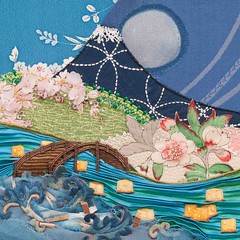
Just a quick progress report on my Sake Box -- Phase IX for Japanese Embroidery.

I've completed all those goldwork cherry blossoms and curlicues on the main round box.  Phew!


According to my Toggl timer, the goldwork on the lid only took me 31 hours. 

One of the reasons it may have taken so long was all the corners that have to be turned in each petal...


That plus sinking all the gold threads of those curlicues.  I'm so glad to have that section finished.  

I'm very fond of cherry blossoms and these versions in gold are the bomb!


After I finished the cherry bombs blossoms, I transferred the design for the honeysuckle vine on the ladle.  Yes, that rectangular shape is actually a sake ladle; the orange is the interior and the black is the outside.  It might all come clearer when I finish stitching the ladle's other components.  Then again, maybe not.

Today I'll begin couching the gold vine on top of the foundation...


I am hoping that the lack of corners in this goldwork will make it all flow more quickly.  

Thanks for stopping by to check on me.  Now I'm back to work.

Happy Day everyone.

Thursday, October 3, 2013

Gilt and Silk

Today, I'm reminiscing about the Gilt and Silk exhibit at the Burrell Collection in Glasgow, Scotland which runs through December 23, 2013. 


There were so many needlework gems in the textile collection at the Burrell but having this exhibit currently running while I was visiting was icing on the cake.

I already shared two of the coifs that were on display a couple weeks ago in this post.  There were also a number of sweet bags; this one being my favorite...

Sweet bag, British, 1600-1630
And a pair of silk and metal gloves in excellent condition...

Gloves, British, 1610-1630

Gloves were very popular in the 17th century as a way of showcasing wealth.

One of the largest pieces on exhibit was this ladies waistcoat with rinceau (foliage) design of scrolling vines and flowers...

Waistcoat, British, 1615-1618


The sweet briar rose is shown with five petals and open, symbolic of courtly love...


I like how the stripey caterpillars are intersecting the scrollwork...


This scroll design was very popular in the Medieval and Renaissance periods and is repeated on a number of other embroidered waistcoats in museum collections.  You might remember a very similar pattern from this post on the Plimoth Jacket.  

And here it appears again on this nightcap on exhibit...


The other large item on display at the exhibit was this embroidered satin petticoat from 1610-1620 never before seen by the public...


To me, the embroidery style seemed similar to that of Asian embroideries that I've seen...


But I have no idea if this is the case.  There were many thistles embroidered on the piece...


And it is believed that it might have belonged to Anne of Denmark, wife to James VI and I.


As part of the exhibit, the museum commissioned a special film demonstrating how these garments were created and worn. 


All in all, the Burrell collection had some of the finest needlework examples of 16th and 17th embroideries that I've ever seen on display at one time.

It was a garden of textile delight and I highly recommend a trip there if you ever find yourself near Glasgow.  Sadly, the museum gift shop did not sell one postcard, image or book of any of their embroideries.  *sniff*

However, they did allow photographs and for that, I am grateful.

Other posts regarding the textiles of the Burrell Collection:

Mirror, Mirror, on the Wall

A Tisket, A Tasket

A Tale of Two Coifs

Thursday, September 12, 2013

A Tale of Two Coifs

Today I'm back at the Burrell Collection in Glasgow.

I wasn't lying when I said they house an amazing needlework collection.  

Though there were many coifs on display as part of the Gilt and Silk exhibition, I chose two of my favorites to share here today.

The first piece is linen with silk and silver-gilt threads circa 1610-1620 and is part of a coif.  


A coif was a woman's close-fitting cap usually worn at home or under a hat when out in public.

This design incorporated four red carnations.


 The Greek word for carnation is dianthus which means "heavenly flower"...


I thought I had captured all four flowers but I'm missing one.  

Here's a good close-up of two different types of leaves.  I'm particularly fond of the vein in the bottom leaf...


This second coif took my breath away when I first saw it.
\

I've always loved silver and gold together and this piece is exquisite...


It still holds much of its lustre and allure even though it was made over 400 years ago...


The size is approx. 25cm x 45cm.

Another element of its appeal is the number of goldwork stitches used throughout.  I love these two strawberry motfis...


And it looks like another "heavenly flower" is on this coif as well...


The design also included pea pods. 


The visibility of the seeds was suggestive of courtship and fertility.


Perhaps, if you've been lucky enough to have been a student of Tricia Wilson Nguyen's Goldwork Master Class, you may recognize some of the stitches?

I do have pictures of some other coifs from the exhibit.  I'll let you know when I get them loaded up on my Flickr account.

Have a brilliant day everyone.

Related Posts with Thumbnails